


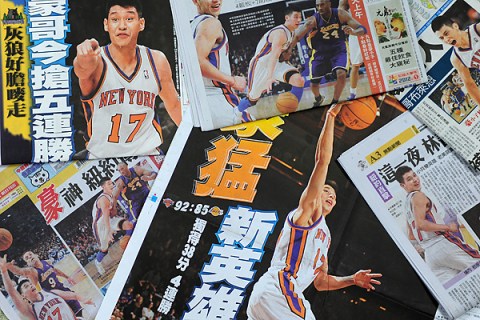
Jeremy Lin, of the New York Knicks, is featured on numerous newspapers in Taiwan on Feb. 12, 2012
America can’t get enough of Jeremy Lin — nor can anyone else. Less than a week after leading the Knicks to a five-game winning streak, Taiwanese-American point guard is the most searched item on Baidu, a leading Chinese search engine, and he already has a quarter million followers on Weibo, a Twitter-like microblog. Everybody, it seems, is talking about the Harvard-educated wunderkind.
In Asia at least, most comments seem pleased to see a high-profile Chinese-American in sports. Wang Lee-hom, a Taiwanese-American celebrity with over 13 million followers on Weibo, tweeted in Chinese Tuesday: “Perhaps you all guessed what today’s Weibo is going to be? It’s about the NBA’s first ABC [American-born Chinese] Jeremy Lin! Representing Chinese right now in the U.S., breaking many long-held stereotypes, opening Americans’ eyes!”
(MORE: A Second-by-Second Look at Jeremy Lin Lighting Up Toronto)
Chinese state media are also chiming in on “Linsanity” or Linfengkuang, while comparing the 23-year-old to more established NBA stars Yao Ming and Yi Jianlian. A mere moment in the spotlight has press pondering, Can Jeremy Lin replace Yao Ming?
Chinese state media Xinhua lauds his academic background, citing his academic success as a possible advantage on the court. But it also harps on the distinction in allegiance between former Houston Rocket, Shanghai-born Yao, who was forced into early retirement this year, and the Silicon Valley native Lin. The People’s Daily, along with Xinhua, claims Yao’s success hinges on his fully Chinese upbringing, while Lin, an American, should only be seen in contrast with American luminaries such as Kobe Bryant and Michael Jordan.
Still, Lin identifies with China’s national hero. “I talk to Yao after every game,” Lin told the New York Daily News. “He’s taken me out to eat every time we’re in the same city. He’s obviously a role model and a big brother to me, and we keep in touch all the time.”
(MORE: Eric Liu: Jeremy Lin Makes Us All American)
Though Lin’s relationship with Yao must warm the hearts of basketball fans on the Chinese mainland, his Taiwan ancestry is a source of awkwardness for some. (Beijing still considers Taiwan — long protected by U.S. power in the Pacific — a renegade province.) “Recently, Jeremy Lin has been hot. I don’t really understand it. His parents are Taiwanese. Is he representing the China team? Why is everyone rushing to support him? We should care more about Yi Jianlian,” one Weibo user posts in Chinese. The majority of the Chinese media, though, have yet to take issue with his background, only sometimes obscuring his Taiwanese heritage by referring to him as “ethnically Chinese.”
Meanwhile, the Taiwanese press have lapped up Lin’s burst into stardom, hailing him as a role model for youth, while endearingly calling the 6-ft. 3-in. baller “the little guy from Harvard.” Lin has spent the past two summers in his parents’ homeland, coaching a free summer camp as well as speaking to teenagers about the benefit of sports.
Lin’s humble demeanor and his ease engaging with both sides of the Pacific offer a valuable lesson for both Chinese and Americans still unhealthily fixated on identity. As former TIME writer Ling Woo Liu points out on CNN.com, Lin’s fame arrives on the heels of a wave of recent incidents of discrimination against Asian-Americans in the U.S., including an offensive political ad and the hazing of Asian-American soldiers. Even after Lin’s outstanding victory over the Lakers, FoxSports.com national columnist Jason Whitlock tweeted, “Some lucky lady in NYC is gonna feel a couple inches of pain tonight.”
(MORE: The Greatest Soccer Player on Earth, Except in His Home Country)
Whitlock has since apologized for the tweet, a vulgar slur that ought not detract from what is a truly transcendent moment for Lin and American sports. As one Beijing resident tells the Straits Times: “He typifies the American dream where any ordinary person who works hard can do great things — and more. He looks like us, he’s built like us; he sends the message: You can do it.”
— With reporting by Natalie Tso / Taipei and Vanessa Ko / Hong Kong
LIST: Top 10 Sports Moments of 2011
READ: End of a Dynasty: Yao Ming Retires and China Wonders Who’s Next?