


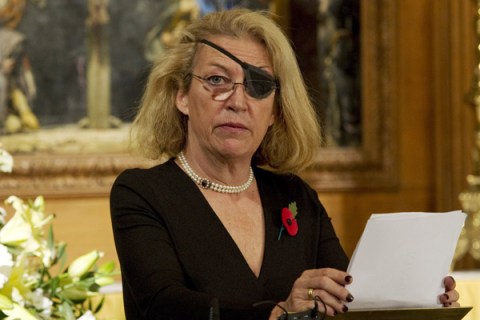
Marie Colvin of The Sunday Times, gives the address during a service at St. Bride's Church November 10, 2010 in London, England
To conflict journalists, a tiny, tight-knit tribe, tragedy is practically an occupational requirement: our work requires us to seek it out, measure it, contextualize it, and chronicle it. It’s impossible to be totally desensitized by the trauma and sorrow of war, but, in time, we learn to suppress emotional reflexes and do our job. When tragedy strikes one of our own, however, even the most hardened of us must allow themselves a tear.
It has been a ghastly week for our tribe. We’ve not yet come to terms with the death, in Syria, of the New York Times‘ Anthony Shadid, unarguably the finest foreign correspondent of his generation. And now comes news that another of our giants, Marie Colvin of Britain’s Sunday Times, has fallen in that bedeviled land. She, along with photojournalist Remi Ochlik, were killed in shelling by government forces in the blood-spattered city of Homs.
I did not know Marie Colvin. We met once, at a nondescript party in London in the fall of 2003. It was a big event, but each of us had been told the other was in the room somewhere, and we set out looking for each other — in an unfamiliar setting, you always seek out your own kind. She was already a legend in the tribe: her heroic journalism had cost her an eye, to shrapnel in Sri Lanka, but not her unfaltering gaze upon the horrors of war, and the crimes of its perpetrators. I had heard she was also a brilliant raconteur. I was especially keen to hear her stories from Iraq and the Second Palestinian Intifadeh, conflicts we had both covered.
Alas, we had too little time: there were too many people who wanted her attention, and we barely spoke for 15 minutes. Most of that time was spent exchanging information on others of the tribe. Had I seen Dexter recently, and was he okay? She had bumped into Rajiv, and he looked well. Is John watching his diet? Had Mick recovered from shrapnel wounds?
We were checking to make sure our tribe was accounted for.
The tribe has lost three members this week. When I bump into one of my kind today—Matthew McAllester, veteran of the Balkans, Palestine and Iraq, sits nearby—I know I’ll see the sorrow in his eyes that he sees in mine. We will fumble over some words. “Horrible business,” is my usual response. We’ll exchange Marie Colvin stories, but it will feel terribly inadequate.
But the moment will pass. We will suppress our emotions again, and return to the tragedies of our time. Tony, Marie and Remi would have it no other way.