


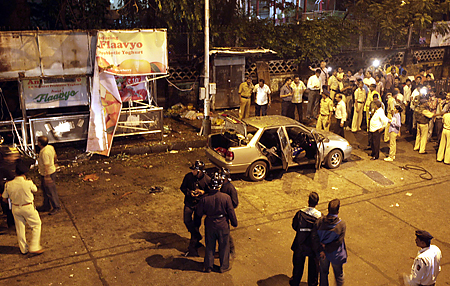
Police inspect the site of an explosion at Dadar in Mumbai, India, Wednesday, July 13, 2011. (Photo: Rajanish Kakade - AP)
There’s no reason yet to believe the latest Mumbai terror attacks bear the same signature as the 2008 massacre that left 164 people dead. Wednesday’s multiple explosions appear from early reports to have involved small-scale and relatively crude bombs, even though they appear to have inflicted substantial casualties. That might point to some local perpetrator, although terror attacks in India almost inevitably raise suspicions of involvement by a Pakistani hand. And, of course, in the case of the Mumbai Massacre, the perpetrators turned out to have been the Pakistani outfit Lashkar e-Taiba (LeT), which was believed by U.S. intelligence to have longstanding links with Pakistan’s Inter-Services Intelligence (ISI).
There’s no evidence thus far pointing the finger at any Pakistan-based group — and any such suspicions, as raised by India’s Home Ministry in the wake of the bombings, may well prove unfounded. But the political impact of such a strike, were Pakistan to become the focus of suspicion, would play dangerously into the increasingly precarious U.S.-Pakistan relationship.
The Mumbai Massacre raised India-Pakistan tensions to boiling point, and the Bush Administration had to force Pakistan to crack down hard on LeT to deter India from taking direct action against the group on Pakistani soil, at risk of full-blown hostilities breaking out. (The crackdown on LeT proved to somewhat illusory and the group remains active in Pakistan.)
(SEE: Photos of the blasts that rocked India’s financial capital.)
The immediate effect of the 2008 crisis was that Pakistan withdrew thousands of troops deployed against Taliban elements on the border with Afghanistan and moved them to the border with India. While the U.S. has tried in vain for a decade to get the Pakistani security establishment to prioritize the fight against jihadists over the strategic rivalry with India, the militants and their allies in the Pakistani security establishment seek to do the reverse: Stoke tensions with India, in order to keep the generals focused on what the Pakistani military has seen as its existential conflict.
U.S.-Pakistani tensions reached a new low this week with the announcement that the Obama Administration is withholding military aid designated for the Pakistani Army in order to pressure it to do Washington’s bidding against jihadist groups in the tribal wilds along the western border, and against the Afghan Taliban which is headquartered on Pakistani soil. But just as Washington is putting the squeeze on Pakistan’s generals to do more to help the U.S. war effort in Afghanistan, the Pakistani public — and even much of the middle-ranking officer corps — is pressing for a sharper break with the Americans, following the humiliation of the Abottabad raid that killed Osama bin Laden, and mounting anger over U.S. drone strikes and other covert operations on Pakistani soil. If the latest terror outrage in Mumbai is deemed by India to have originated in Pakistan, the result will be an escalation of tensions that would further distance the Pakistani military from the U.S. and its priorities. (Even before the latest Mumbai attack, Pakistan’s Defense Minister warned that it might withdraw troops from the Afghan border zone in response to the funding cuts.) And widening the breach between the U.S. and the Pakistani military — and ease the pressure on the ISI’s longtime jihadist proxies — would be a prized goal of the militants themselves, and of their allies within the Pakistani security establishment.
The motive, then, for LeT or any other Pakistan-based jihadist group to launch a new strike on Mumbai is plain to see. But that’s hardly enough to pin the blame on Pakistan. In the proverbial “land of a million mutinies”, there could be any number of “usual suspects” with the motive and means to carry out the latest round of bombings.
MORE: The journey, through photos, of one of the terrorists who attacked Mumbai in 2008.