


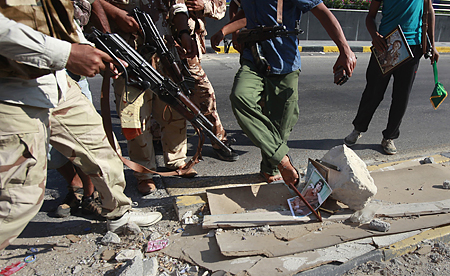
Libyan rebel fighters step on a picture of Muammar Gaddafi at a checkpoint in Tripoli's Qarqarsh district on Aug. 22, 2011 (Photo: Bob Strong / Reuters)
If the dramatic advances in recent days that have taken opponents of Libyan leader Muammar Gaddafi toward — then into — Tripoli have thus far elicited only the most careful responses from tight-lipped Western leaders, there’s a good chance those officials are showing more emotion over the conflict, which is apparently nearing an end, in private. For as long as such relief and glee will last, anyway. Because if the fall of the Gaddafi regime will mute the criticism about the wisdom of the NATO-led intervention in Libya’s grinding civil war, the transition from the brutal regime to a post-dictatorial government will inevitably raise questions about how the international community handled the Libyan challenge — and whether the outcome was worth that effort.
By midday Monday, it seemed clear that the rapid progress of the Libyan rebels, which took them deep into Tripoli on Sunday, had all but closed out the 42-year ironfisted Gaddafi regime. News reports on Monday said triumphant opposition fighters controlled all but 10% to 15% of the capital and that they had taken two of the dictator’s sons into custody. This stunning advance, after months of standoff in the civil war, led French President Nicolas Sarkozy and German Chancellor Angela Merkel to ramp up earlier appeals to Gaddafi to give up his seemingly futile struggle and spare Libya further bloodshed. Similarly, U.S. President Barack Obama warned that “Muammar Gaddafi and his regime need to recognize that their rule has come to an end.” Late Monday morning, French Foreign Affairs Minister Alain Juppé held a press conference to convene Western officials and representatives of Libya’s opposition leadership to Paris next week to discuss an orderly transition and reconstruction process under United Nations coordination. And as new reports flowed in that rebel fighters had closed in on the Tripoli compound where Gaddafi was thought to be holed up, Juppé urged the Libyan dictator to recognize that “it’s finished. It’s over. The fighting must stop now.”
Given the confusion and chaos of the events in Libya, it remains difficult to fully explain how the rebels managed to transform their previous stalemate with Gaddafi loyalists into a stunning — and apparently victorious — final offensive so quickly. According to reports in the New York Times, advances over the past couple of weeks coincided with increased coordination and planning between NATO airpower and Libyan rebels. If accurate, that more integrated operation between Libyan militants and NATO surveillance and bomber aircraft marked another step by Western capitals toward active, openly partisan involvement in the military drive against Gaddafi.
Previously, France and the U.K. sent military advisers to assist and train anti-Gaddafi forces, with Paris later acknowledging that it had even supplied them with arms. Recent decisions by Washington and London to follow Paris’ earlier recognition of Libya’s opposition as the legitimate representative of the country, meanwhile, resulted in their sending billions of dollars in frozen Gaddafi assets abroad toward the rebel capital of Benghazi for use in the fight. In the end, all that apparently added up as the very time Western leaders were growing anxious for a horizon to appear.
“This sudden advance by rebels was a sign that better training, financing and arms had really begun to pay off, but it also reflects that a clear political decision in Western capitals had been taken to get this thing over quickly,” says Karim Emile Bitar, a Middle East specialist at the Institution of International and Strategic Relations in Paris. “The war had already started to pose serious political problems for [U.K. Premier David] Cameron as well as Sarkozy as he prepares for his re-election next spring. Even Obama is facing serious legal questions on his move to avoid consulting Congress on Libya under the War Powers Resolution. So this final breakthrough is a result of real progress and improvement among rebel fighters as well as the political decision by Western leaders that they couldn’t afford to let their intervention in the conflict drag on past six months.”
So why aren’t diplomats in Washington, London and Paris performing public high fives over Gaddafi’s apparent last hours in nominal power? Perhaps because what Bitar calls “the understandable and legitimate relief” in seeing the war nearing an apparent end is likely to be followed by a period of uncertainty that will also carry high stakes. He says the focus now in Western capitals will be to use whatever influence and power they have over the rebels and their leadership to prevent reprisals or massacres in the wake of Gaddafi’s fall. Those actions, Bitar warns, would only create division within the country and spark outrage around the world. Meanwhile, news reports and other information about the final offense that comes out of Libya in the coming days will also play a large role in shaping the views of a wide range of players — on many issues — about how the final push came together.
“There’s already a lot of debate on whether NATO-led forces overstepped the legal limits of their U.N. mandate to protect civilians by becoming a de facto combatant against Gaddafi’s troops in support of rebels on the ground,” says Bitar. “There is a risk that if we learn the final offensive was built on a clear and active partnership between the two forces, that will raise even more questions about legality — especially in the event we find out atrocities or massacres were committed in the drive on Tripoli. If so, NATO would wind up being called an accomplice in that by detractors, and further fan legal challenges to the intervention.”
For the moment, there’s no reason to suspect that offenses have been committed by rebel troops. Meanwhile, increased debate about the legality of NATO activity under the U.N. mandate is unlikely to gain much traction in Western public opinion, which recognized long ago that the mission was aimed at toppling the Gaddafi regime — and might well respond to more efficient, stepped-up action to obtain that goal with a pragmatic shrug. Such a reaction is even more probable given the recent indications that the rebel side is close to splitting asunder — and given the clear desire of Western public opinion that the long, costly conflict be brought to an end quickly.