


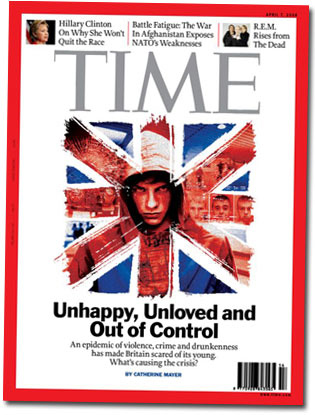
 On Sept. 13 the BBC’s main evening news flashed up a TIME cover. There’s nothing particularly unusual in our stories making headlines in other media, but this was more than three years after publication. The story in question, about why Britons appear scared of their kids, and to what extent they’re right to be so, provoked comment and criticism when it first appeared, and as recently as August attracted fresh attention as England puzzled over the causes of the riots that erupted suddenly and violently. It was evident that many of the rioters were young and deprived. But it was also clear that many of them were neither young nor deprived. The point about age isn’t too hard to explain—unhappy, unsocialized children grow up into unhappy, unsocialized adults—but the roots of Britain’s malaise are clearly more complex.
A report published on Sept. 14 explores those roots. Children’s Wellbeing in UK, Sweden and Spain: The Role of Inequality and Material was undertaken by research organization Ipsos MORI in partnership with Dr Agnes Nairn for Unicef UK. This followed aUnicef report in 2007 that ranked the UK bottom in child wellbeing, compared to other industrialized nations. The new study reveals endemic deprivation among British kids. But what they lack is parental attention, not possessions. The researchers observed British parents attempting to pacify children, and protect them from bullying, by showering them with high-status brands. “Parents in the U.K. almost seemed to be locked into a system of consumption which they knew was pointless but they found hard to resist,” Nairn said.
Here’s a British father of a young child, quoted in the report:
In the last two years, she’s gone through about ten brand new phones. I think it’s ludicrous. She’s broken some of them, she’s dropped one in the toilet (laughs).
Unicef has called for a ban on advertising aimed at the under-12s and is also lobbying the government and local authorities to preserve playgrounds and other facilities under threat from austerity measures as Britain seeks to trim its budget deficit. Persuading parents to work shorter hours in such a tough economic climate is a bigger ask. But the riots gave Britons a glimpse of the dangers of ignoring the pressures that are building and threaten to find explosive release in future. “If I was sitting in government, I’d be really worried,” Camila Batmanghelidjh, the founder of Kids Company, a organization working with some of London’s poorest young, told me in 2008. “Not about terrorist bombs but about this.”
Catherine Mayer is London Bureau Chief at TIME. Find her on Twitter at @Catherine_Mayer or on Facebook at Facebook/Amortality-the-Pleasures-and-Perils-of-Living-Agelessly . You can also continue the discussion on TIME’s Facebook page and on Twitter at @TIME .