


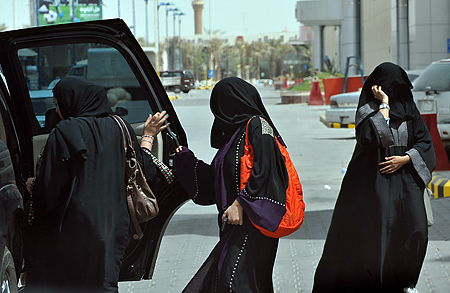
Saudi women get into the backseat of a car in Riyadh on June 14, 2011. (Photo: Fayez Nureldine / AFP / Getty Images)
Update: Al-Jazeera reports that the Saudi King Abdullah has overturned the lashing verdict.
Just days after King Abdullah granted Saudi women the right to vote and run in municipal elections scheduled for 2015, a court convicted a woman of driving without permission and sentenced her to lashing. It is the harshest sentence yet and a stark reminder that despite real gains, the Kingdom’s rigid social order endures.
The conviction comes after months of protests by female activists. In June, Time’s Middle East correspondent, Aryn Baker, road along with Maha al-Qatani, the first woman in Saudi Arabia to receive a traffic ticket, as she took to the street—and her car—in protest. Inspired by the wave of unrest sweeping the Arab world, she and dozens of others have risked arrest by defying a rule that leaves them dependent on paid chauffeurs or male relatives for rides. “If no one sacrifices, no one will get their rights,” she said the day of her first drive. Manal al-Sharif, who helped pioneer the campaign, was arrested and then released.
There is no Saudi Law that prohibits women from driving. Rather, it is a religious edict that keeps them from getting behind the wheel. Conservative clerics and their allies insist the guidelines protect women and prevent illicit mixing. “This is to protect our women from harassment and to protect society from the problems you see in the West — single mothers and illegitimate children — that come from unconditional relations between men and women,” Sheik Abdallah al-Oweardi, a religious scholar, told Baker. Over the years, there have been many calls for change—and promises of reform, too. In 2005, King Abdullah told Barbara Walters, “I believe the day will come when women drive.”
It is telling, in many ways, that the voting decree and the sentence came in such quick succession. The tension between reformers and conservatives—and indeed, between different factions of the ruling family—has been tested by the Arab spring. Spooked by the wave of popular unrest in the region, the country’s rulers moved swiftly, spending billions on bonuses for government workers and public works projects. The Royal family also reached out to religious authorities, lavishing $200 million on various organizations. Of course, the same events have emboldened activists, who continue to wage a campaign for the right to drive (#women2drive, on Twitter). In some ways, the country’s women are well-placed to take on the system. I’ll quote, again, from Iranian-American scholar Farzaneh Milani, who takes a long view of the protests:
The women demonstrating for the right to drive in Riyadh are seasoned negotiators of confined spaces and veteran trespassers of closed doors and iron gates. They are a moderating, modernizing force to be reckoned with — and an antidote to extremism.
Their refusal to remain silent and invisible or to relinquish their rights as citizens is an act of civil disobedience and moral courage. Their protest, and those of their sisters across the Middle East, represent a revolution within revolutions — and a turning point in the contemporary history of Islam.
In other words, there may be real change further down the road.
Update: The Associated Press has since reported that Saudi King Abdullah has overturned the court decision regarding the incident on Wednesday.